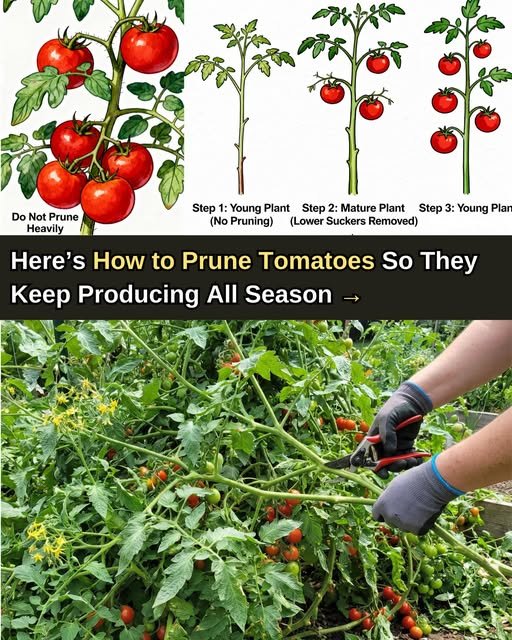
Ever noticed how most gardening advice floating around sounds like your grandma’s incantations to her prize-winning tomatoes? You hear it, you nod, but when you’re actually standing in front of your own sprawling plant… suddenly the magic feels a little lost in translation.
There’s no voodoo, no chanting under a full moon, no elaborate rain dances required for a bumper tomato crop. Just simple, strategic pruning. Snip-snip, and watch the real magic unravel.
Why You Should Prune Tomato Plants in Spring

Your tomato is, in fact, an overachiever. Left to its own devices in spring, it will enthusiastically produce a mass of leaves and stems. While this might seem like a good sign, it delays your ultimate goal: a bountiful harvest.
Pruning redirects the plant’s energy from excessive foliage to more and larger fruit.
Besides, opening up the plant’s structure improves air circulation and reduces the risk of fungal diseases that thrive in dense, humid conditions. Finally, a well-pruned plant makes later maintenance, watering, and, most importantly, harvesting way easier.
🌱 Get Your FREE 2026 Sowing Calendar! 🌱
Plan your best garden yet! This printable 2026 Sowing Calendar tells you exactly when to plant your favorite vegetables, herbs, and flowers for a thriving garden all year long.Get My FREE Calendar
We use your personal data for interest-based advertising, as outlined in our Privacy Notice.
We also recently put together an article full of practical tips for boosting your tomato harvest, I thought you might like to give it a read.
First of All: Know Your Tomato Type Before You Prune!

Tomato pruning isn’t a one-size-fits-all kind of business. Every aspiring tomato farmer must answer a very important question: What kind of plant am I dealing with?
We primarily categorize them into two main types: indeterminate and determinate.
- Indeterminate varieties are the energetic climbers, growing tall and vine-like throughout the season. These are the ones that truly benefit from regular and strategic spring pruning to manage their growth and maximize fruit production.
- Determinate tomatoes are bushier plants with a more compact growth habit. They reach a certain size and then focus on setting all their fruit at once. Only light pruning is usually recommended for this type.
So, the essential first step is to know whether you have a vining ‘Sungold’ or a bush-type ‘Roma’ before even reaching for your pruners.
Tools and Timing: What You’ll (Really) Need!

Good news, you don’t need a shed full of tools. The most important one is a pair of clean, sharp pruners or scissors. Sharpness matters because clean cuts minimize stress on the plant and the risk of disease entry.
While optional, gloves can protect your hands from sap and potential irritants. If you plan on training your indeterminate tomatoes, have tomato clips or support ties handy.
Timing-wise, aim to prune in the morning on a dry day. Cuts will dry quickly, further preventing the spread of disease. So, start the pruning process when your tomato plant is about 12 to 18 inches (30 to 46 cm) tall and has developed several sets of true leaves (these are the mature, characteristic leaves that appear after the initial seedling leaves).
Step-by-Step: How to Prune Tomatoes in Spring

🌱 Get Your FREE 2026 Sowing Calendar! 🌱
Plan your best garden yet! This printable 2026 Sowing Calendar tells you exactly when to plant your favorite vegetables, herbs, and flowers for a thriving garden all year long.Get My FREE Calendar
We use your personal data for interest-based advertising, as outlined in our Privacy Notice.
The time has come for the not-at-all-scary step-by-step open-plant surgery of your indeterminate plants. Remember, determinate tomatoes are low-maintenance types preferring a quick haircut, not a full-on makeover.
1: Remove the Bottom Leaves

Take a good look at the bottom of your tomato plant. Should you see any leaves making contact with the soil or getting very close, remove them. Just use your sharp pruners or scissors for a clean cut. It will ensure soil-borne diseases don’t ketchup to your plant’s health after watering or rain.
2: Identify and Remove Suckers

Next, focus on locating and eliminating “suckers.” Small shoots sprout in the junction between the main stem and a branch (the leaf axil).
These suckers know well what they’re doing and if you allow them to develop, they become additional stems. Next thing you know, you have a bushier plant with poor airflow and less fruit. So, tackle suckers when they are small, just a few inches in length.
Often, you can simply pinch them off with your fingers. Use your pruners for larger ones, to make a clean cut close to the main stem.
AD
3: Train to One or Two Main Stems (for Indeterminate Types)

🌱 Get Your FREE 2026 Sowing Calendar! 🌱
Plan your best garden yet! This printable 2026 Sowing Calendar tells you exactly when to plant your favorite vegetables, herbs, and flowers for a thriving garden all year long.Get My FREE Calendar
We use your personal data for interest-based advertising, as outlined in our Privacy Notice.
For indeterminate tomatoes, a common practice is to train them to a single or double main stem.
AD
Early in the season, select one or two strong, upright-growing stems as your leaders. Then, prune away any other significant stems emerging from the base of the plant.
You’d want to concentrate the plant’s energy and help it establish a more open and manageable structure. The idea is to simplify support, watering, and harvesting later in the season so there’s no need to grapple with a tangled mess.
If you’re growing other tomato types too, we also have a full guide on pruning determinate bush tomatoes and a step-by-step guide for cherry tomatoes.
4: Trim Crowded Interior Growth

AD
As the plant grows, small, congested branches might appear in the center. Such growth can hinder airflow and limit light reaching the inner parts, potentially increasing the risk of disease and delaying fruit ripening.
Carefully prune away some of the dense inner growth to improve ventilation and allow sunlight to embrace more of the plant’s foliage and developing fruit.
5: Prune Above Flower Clusters (as the Plant Grows)

🌱 Get Your FREE 2026 Sowing Calendar! 🌱
Plan your best garden yet! This printable 2026 Sowing Calendar tells you exactly when to plant your favorite vegetables, herbs, and flowers for a thriving garden all year long.Get My FREE Calendar
We use your personal data for interest-based advertising, as outlined in our Privacy Notice.
AD
Throughout the growing season, continue to observe your indeterminate tomatoes. Once a flower cluster develops, prune the stem a few inches above it, always making your cut just above a leaf node (the point where a leaf grows from the stem).
That will encourage the plant to focus on developing the existing fruit, a surefire way to sauce up your harvest.
(Really!) Important Tips for Supporting Pruned Tomato Plants

AD
You pruned for better growth, now support it well! Use cages, trellises, or stakes to prevent collapse when fruit gets heavy. Tie single or double stems gently as they grow taller.
Also, take a look at our article about tomato support ideas to keep your plants upright, it’s definitely worth checking out if you’re planning your setup.
Good support with pruning boosts how much you get and makes harvest easy. It also keeps ripe fruit off the soil. So, don’t let your hard work fall flat. After all, you don’t want your prize-winning tomatoes to squash their potential!


